
Barcelona has no shortage of great food. But if you have never sat down to a bowl of smoky jollof rice or a plate of slow-cooked egusi soup, you are missing a lot. You have probably heard about jollof rice, maybe you have even tried it. But Nigerian food goes far deeper than one dish. It is bold, deeply layered, and built on flavours that stay with you. This is your starting point.
There is a particular kind of satisfaction that comes from Nigerian food. It is not the kind you feel immediately, although you will feel that too. It is the kind that settles in slowly, the kind that makes you think about the meal hours later and wonder when you can have it again. Nigerian food is home cooking in its most serious form. It is food that was designed to feed people properly, to mark occasions, to bring families to the same table, and to taste like someone spent the entire day making it because they usually did.
If you are in Barcelona and you are curious, whether you are a tourist passing through, an expat who has been here for years, a Nigerian missing the food from home, or simply someone who loves eating well and wants to go further than the usual options, this guide is for you. We are going to walk through some dishes, sort out the misconceptions, explain the correct pairings, and show you exactly where to start.
Nigerian cuisine is one of the most diverse on the African continent. Nigeria has over 250 ethnic groups, each with its own food traditions, and what you find on the plate depends heavily on where in the country the cook comes from. Yoruba food from the south-west is different from Igbo food from the south-east, which is different again from Hausa food from the north. What unifies all of it is a commitment to flavour that is built rather than added. Nigerian cooking builds seasoning into every layer of the cooking process. And the result is food that tastes like it has been cooking all day. In most cases, it has.

This is where most people start, and for good reason. Nigerian Jollof rice is Nigerian party food and everyday food at the same time. Rice cooked directly inside a rich tomato and pepper base, spiced deeply, and finished over high heat until the bottom catches slightly and develops what Nigerians call the party Jollof crust. It is not the same as rice with tomato sauce on top.
The rice absorbs the base completely, so every grain carries the full flavour. It is smoky, deeply savoury, and slightly spiced without being aggressively hot. Jollof rice is typically served with a protein, chicken, beef, or fish, and with fried plantain on the side.
The sweetness of the plantain against the smokiness of the rice is one of the great combinations in Nigerian food. What it is not is a one-dish meal. Jollof rice is the beginning of the conversation, not the whole thing.
Egusi Soup is made from ground melon seeds cooked slowly in a spiced pepper base with palm oil, leafy greens, and assorted meat or fish. The texture is thick and rich. The flavour is nutty, deep, and unlike almost anything in European cuisine, but it rewards anyone willing to give it the attention it deserves.
Egusi soup is eaten with a variety of sides including swallow (Eba, Amala, Pounded Yam, Fufu etc), and so much more. This is an important distinction that we will come back to shortly, but the key thing to understand here is that the soup and the swallow are a pair. You eat them together.
The swallow (has a dough-like consistency) is torn into a small piece, dipped into the soup, and eaten in one movement. It is a completely different eating experience from anything most European or Western diners are used to, and it is one of the most satisfying things you can do with a bowl of food.


Efo Riro is a Yoruba Leafy Vegetable stew and one of the most popular soups in Nigerian cooking. It is made with shredded leafy greens cooked in a deeply spiced pepper and palm oil base, loaded with assorted protein including beef, fish, and in traditional preparations, various smoked and dried additions that give the soup a complexity that is very difficult to describe and very easy to understand once you taste it.
Like Egusi, it can be eaten with a swallow, Rice, Plantain and some other pairings.
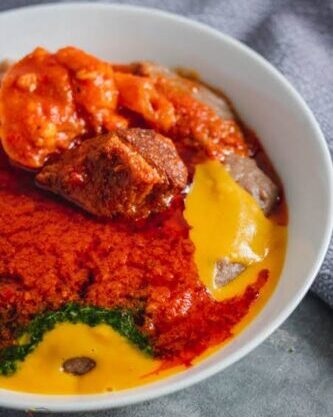
Abula is a Yoruba food experience and one of the most comforting combinations in Nigerian cuisine. It brings together three things: Amala, which is a dark, slightly earthy swallow made from yam flour; Gbegiri, which is a smooth, thick bean soup; and Ewedu, which is a light, slightly mucilaginous leafy green soup with a texture that is distinct and important to the dish.
These three sit together on the plate with a rich Buka-style stew (Obe Ata) poured over the top. You eat it all together, mixing as you go. The textures and flavours work in a way that is entirely its own. If you want to understand what Yoruba home cooking tastes and feels like, the Abula is where you go.

Ewa Aganyin is slow-cooked beans, gone completely soft, served with a dark, caramelised palm oil and pepper sauce that has serious depth of flavour. The sauce is the star of this dish. It is made by cooking peppers and onions down very slowly until they darken and develop an almost smoky sweetness that is completely different from anything a fresh pepper sauce tastes like.
Ewa Aganyin is typically served with fried plantain and, in Lagos, with Agege bread, a soft, slightly dense white bread that is ideal for mopping up the sauce. It is one of the most requested dishes among Nigerians who grew up eating it and one of the biggest surprises for first-timers who were not expecting beans to be this interesting.
Nigerian food has its own pairing logic and understanding it will make your eating experience significantly better.
The reason these pairings matter is that Nigerian food was developed with specific textures and balances in mind. Eating egusi with rice is not wrong exactly, but it is a little like eating a rich pasta sauce with plain boiled potatoes. You can do it, but you are missing what the dish was made for.